Enumerating IEDs#
The iedmap utility provides a structured way to enumerate and inspect
Intelligent Electronic Devices (IEDs) using the IEC 61850 protocol together
with MMS over TCP. It allows to traverse the hierarchical information model of
an IED and extract details about its logical structure.
IEC 61850 Background#
IEC 61850 defines a layered data model built around the following concepts:
Logical Devices (LDs): Abstractions that represent major functional groupings inside an IED - equivalent to MMS domain objects.
Logical Nodes (LNs): Each LN represents a specific function (e.g., measurement, control, protection)
Data Objects and Data Attributes: Hierarchically organized information points that carry actual values and metadata - equivalent to MMS named variables and named variable lists.
The result is a tree of nodes, and variables for a target logical device, which can be displayed in either structured or flat form.
Usage#
iedmap.py [OPTIONS] <host> [-p <port>]
Where <host> specifies the IED (IP address or hostname), and port
(default 102) is the MMS communication port.
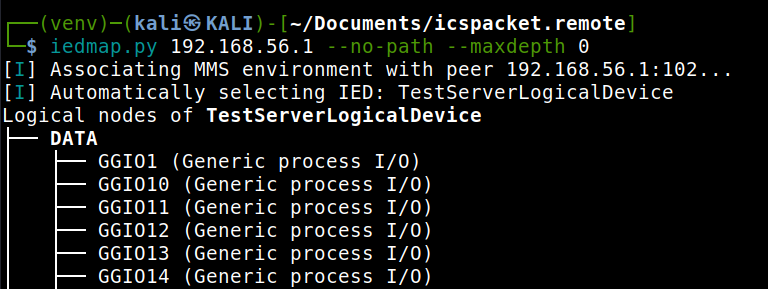
Sample output that displays only nodes at depth zero.#
Output Options#
The following arguments control how information is displayed:
- -L, --list#
Output all discovered nodes as a flat list rather than a hierarchical table/tree.
Note
This option does not respect the
--maxdepthoption.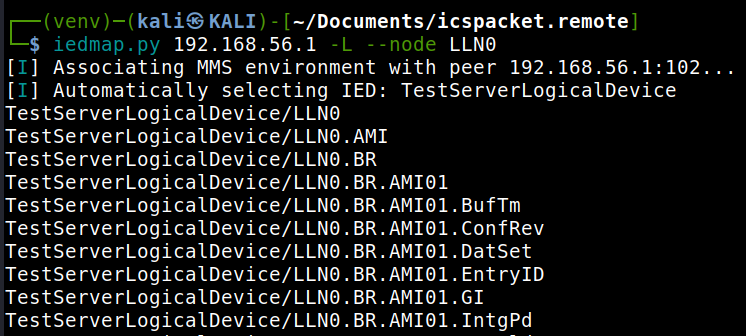
List output of all logical nodes within the device or the selected node.#
- --maxdepth DEPTH#
Limit the displayed hierarchy to a maximum node depth.
- --no-path#
Suppress the display of fully qualified paths for nodes. Normally, paths such as
LD1/MMXU1.A.phsAare shown. With this option, only the node name is displayed.
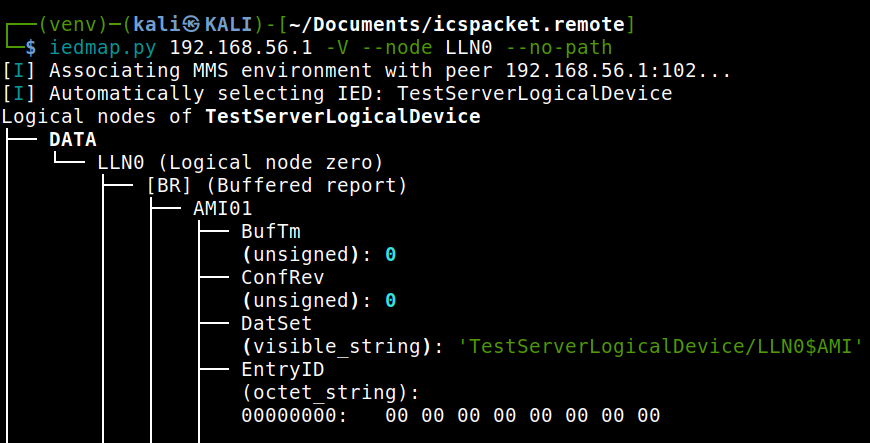
- -V, --values#
Display the current values of nodes alongside their structure. This requires additional MMS
Readrequests to retrieve DataObject or DataAttribute values.